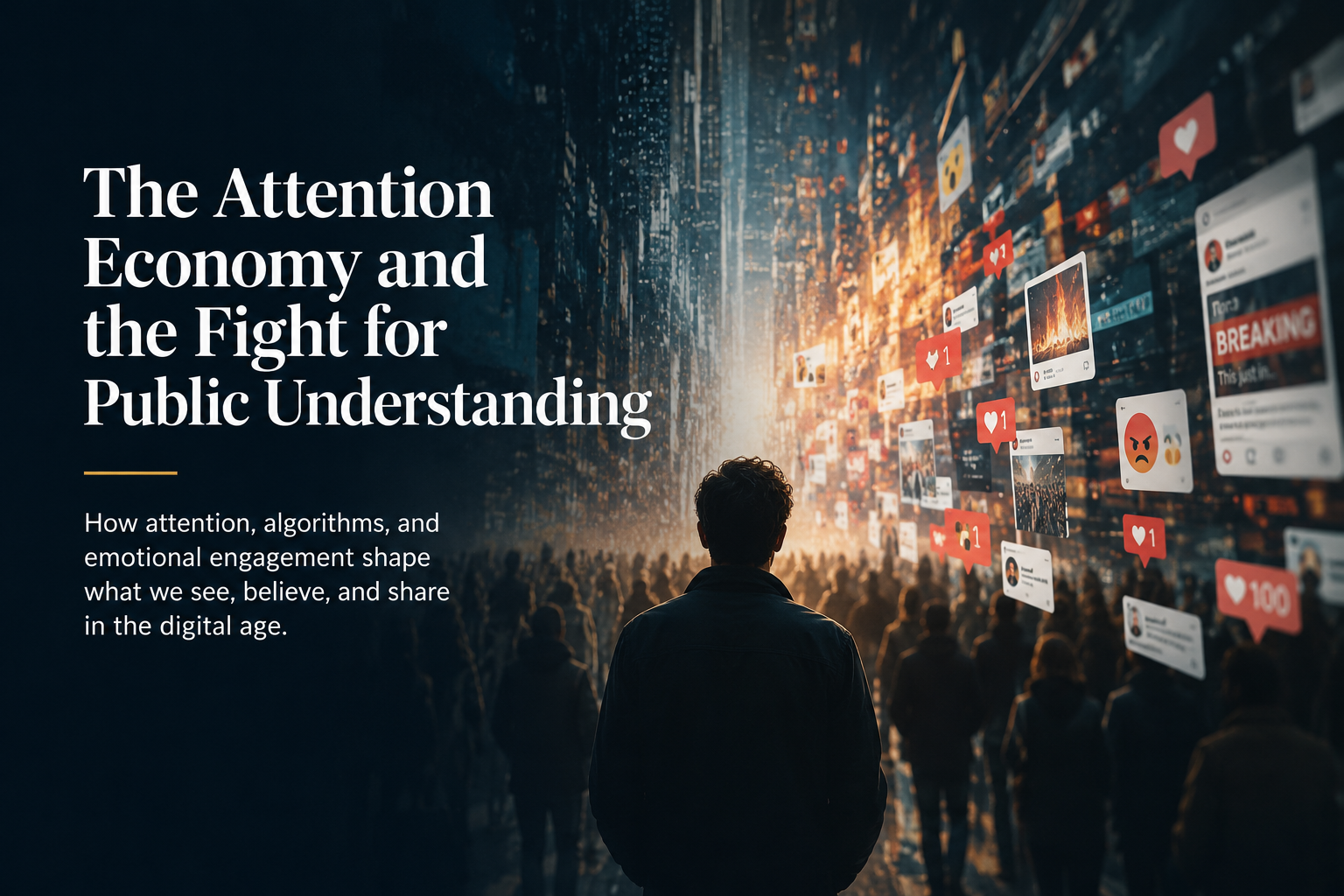

The Attention Economy and the Fight for Public Understanding
“Falsehood flies, and the truth comes limping after it.” Irish writer and satirist Jonathan Swift wrote those words in 1710 during an era of political rumours and sensational pamphlet wars. More than 300 years later, they may describe the modern internet better than ever.
It is easy to think of misinformation as a technological problem, but many of the systems that shape how information spreads online are deeply human. Fear, outrage, certainty, and emotional intensity have always travelled quickly. Digital platforms have simply accelerated and amplified those dynamics at an unprecedented scale.
In today’s digital environment, attention has become one of the internet’s most valuable currencies. Platforms compete for it, creators depend on it, algorithms optimise for it, and narratives spread because of it. These systems often prioritise content that generates strong engagement signals such as shares, comments, watch time, and rapid interaction. However, attention does not always reward accuracy, nuance, or public value. More often, it rewards engagement, especially emotional engagement.
Research increasingly shows that emotionally charged content is significantly more likely to spread online than calm, nuanced, or carefully contextualised information. One of the most widely cited studies on this topic, conducted by researchers from the Massachusetts Institute of Technology, found that false news spreads “farther, faster, deeper, and more broadly than the truth” online. The study also found that false stories were 70% more likely to be reshared than truthful ones and reached people substantially faster across digital platforms.
Other studies examining emotional behaviour online have found that anger spreads more rapidly through digital networks than joy, highlighting how outrage and emotionally reactive content can become especially amplified in online spaces. This is part of what makes the modern information environment so complex. Digital platforms are not simply information spaces; they are also attention spaces. And in the attention economy, visibility is often mistaken for credibility.
At the heart of the attention economy is the simple but important shift that most digital systems are not designed to determine what is true but to determine what holds attention. This distinction matters because attention behaves differently from truth. Truth often requires context, nuance, and time to understand. Attention, on the other hand, is immediate. It reacts, responds, and moves quickly. And in digital environments, what moves quickly tends to get rewarded.
This is where emotional content becomes especially important. Research on online behaviour consistently shows that high-arousal emotions, particularly fear, anger, shock, and outrage, are more likely to be shared than neutral or carefully balanced information. Emotional intensity increases the likelihood that people will react before they reflect. In practice, this means that emotionally charged content often spreads further than information that is accurate but requires more time and context to understand.
Over time, this creates a feedback loop. Content that gets attention is amplified. Amplified content becomes more visible. Visible content is assumed to be more important, and importance is often mistaken for truth. This is one of the most subtle but powerful dynamics shaping digital culture today. It helps explain why misinformation does not always need to be persuasive in a traditional sense. It only needs to be engaging enough to move through networks faster than correction or context. And once something becomes widely visible, correction rarely travels at the same speed or on the same scale. By the time context arrives, perception has often already been formed.
This dynamic becomes especially important when we look at how misinformation spreads online. It is often assumed that false information spreads because people are easily convinced or unable to think critically. But in many cases, the issue is not simply belief; it is exposure. In an attention-driven environment, repeated exposure can begin to shape perception long before something is verified. When content appears frequently enough across platforms, shared by multiple accounts, and reinforced by emotional reactions, it can start to feel credible simply because it feels familiar.
Psychological research has long shown that familiarity can influence belief. The more often we encounter a statement, the more likely we are to perceive it as true, even if we have not independently verified it. In digital spaces, where content circulates rapidly and repeatedly, this effect becomes amplified. At the same time, social reinforcement plays a role. When people see others reacting strongly to a piece of content, whether through sharing, commenting, or expressing fear or certainty, it creates a sense of collective validation. This can further blur the line between visibility and credibility. This helps to explain why misinformation does not need to be widely agreed upon to spread. It only needs to be visible enough, often enough, and emotionally charged enough to circulate through networks faster than context or correction can respond. Digital platforms amplify these dynamics, but they did not invent humanity’s attraction to fear, certainty, conflict, or emotionally compelling narratives.
In many African contexts, where large numbers of people access news primarily through social media and messaging platforms, these dynamics can become especially influential. Important political, social, and cultural conversations increasingly unfold within digital spaces shaped by virality, visibility, and emotional engagement. Over time, this can subtly reshape how people understand events, issues, and even entire communities. This is why I believe conversations around media literacy can no longer focus only on identifying so-called “fake news.” The challenge is much broader than that.
Today’s digital environment is shaped by systems designed to maximise visibility, engagement, and attention. Understanding how information spreads online now requires understanding how algorithms prioritise content, how emotional reactions influence sharing behaviour, and how virality itself shapes public perception. What trends online does not simply reflect society; it also shapes public understanding within it. It influences what people fear, what they focus on, what they remember, and what they begin to see as important.
That is why media literacy today needs to go beyond fact-checking alone. It must also include a deeper understanding of digital systems, attention dynamics, and the emotional architecture of online spaces. People are not unintelligent for struggling to navigate this environment. The modern information ecosystem is overwhelming by design, and recognising these dynamics creates an opportunity. The more people understand how visibility, repetition, emotional engagement, and algorithmic amplification shape online experiences, the more critically and intentionally they can engage with the information they encounter.
In this attention economy, one of the most powerful things we can do is slow down long enough to ask: Why am I seeing this? Who benefits from my attention? What emotions is this trying to trigger? And what context might be missing? Because in the digital age, critical thinking is no longer just an academic skill; it is becoming a life skill.